


 Validating Capabilities Is a Growing Challenge as AI Blurs the Hiring Funnel
Canada’s labour market entered 2026 with mixed signals.
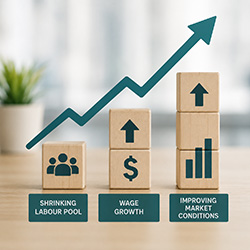
Job losses and rising unemployment point to increased caution from employers. But wage growth remains resilient, consumer demand is holding steady, and conditions are expected to improve as the year progresses.
At the same time, the available talent pool is shrinking due to slower population growth and reduced labour force expansion.
Employers are facing a new reality: fewer workers, more uncertainty, and greater pressure to make the right hiring decisions.
At the same time, hiring behavior has shifted:
- Automated applicant screening
- Larger finalist pools
- Larger interview teams
With wage growth and a shrinking labour pool, market conditions are expected to improve.46

AI Stealth is Creating New Challenges
The biggest misconception entering 2026 was that easing labor pressure and adopting AI-driven screening would make hiring easier.
It has not.
Even as unemployment rises, finding qualified workers is a challenge with 29% of employers reporting they had jobs they could not fill.47
Skill gaps are being identified later in the process or after hire. This increases employer risks tied to:
- Turnover costs
- Productivity
- Compliance
- Employer brand
The Society for Human Resource Management has reported growing employer concerns about skills validation and candidate authenticity in AI-assisted hiring environments. Employers report higher application volume, but with the rise of AI-enhanced resumes that overstate candidate capabilities, finding people who can do the job is taking longer and becoming increasingly frustrating.
AI has Blurred the Hiring Funnel
Candidates are increasingly using AI to generate resumes that closely mirror job descriptions and present highly polished versions of their experience.
At the same time, more organizations are using AI to screen those applications. This creates a new dynamic where resumes are becoming AI-optimized narratives that are tailored, consistent, and harder to validate at face value.
The result is a growing gap between presentation and capability:
- More candidates appear qualified
- More candidates pass initial screening
- More interviews are required to vet actual skills
- Culture fit and long-term attendance reliability factors are being skipped
What looks efficient at the top of the funnel - is creating more work and expense further down.
1Speed Still Matters, but Retention Matters More
Moving quickly remains a competitive advantage. Moving quickly without validation increases employer risk. In an AI-influenced candidate pool, polished resumes are no longer a reliable signal. The competitive advantage will come from human-in-the-loop validation and retention support.
How AppleOne Can Help2Don’t Confuse Easier Market with Easy Hiring
The market is more balanced, but the data still shows persistent gaps in filling key roles. Organizations that plan ahead and understand the new dynamics will win in this new environment.
Schedule a Hiring Consultation3Prioritize Flexibility
The broader economy remains cloudy, but work still needs to be done. In uncertain times flexibility is a superpower.
Discover Ways to Build a Flexible Workforce